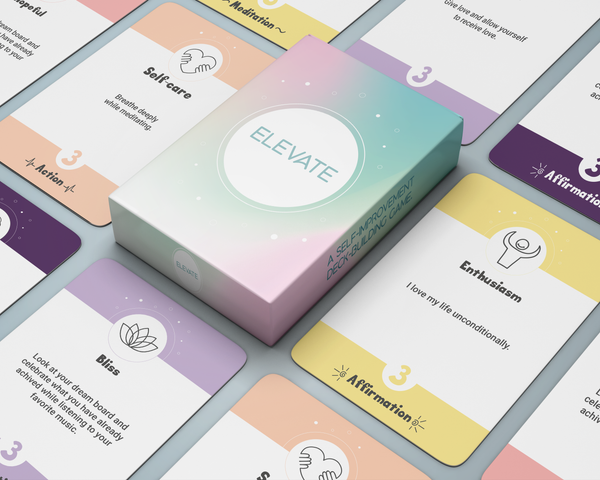
I have never been clinically diagnosed with ADHD. But I've taken enough of those online quizzes late at night to know exactly where I land, and it's not a close call. What I actually have is twenty-plus years of watching my own brain refuse to cooperate with every single productivity system, planner, and self-help book I have ever tried, alongside a strange exception, competitive card games and gamified quest systems, where my focus has always been effortless. That contrast is where Elevate actually came from, and it turns out there is real science behind why it works.
The interest-based nervous system
Dr. William Dodson, a psychiatrist who spent more than three decades specializing in adult ADHD, describes it as an interest-based nervous system rather than an importance-based one. A neurotypical brain can force itself through a boring but important task using willpower and long-term reward. An ADHD brain, by contrast, needs a task to be novel, urgent, challenging, or genuinely interesting in the moment to generate enough dopamine to even begin. Importance alone does not reliably trigger action. This is the actual mechanism behind what people call ADHD paralysis, not laziness, a literal difference in what activates the brain's executive function. Dodson's own summary of it is worth sitting with: attention deficit is a misnomer, because the attention isn't missing, it's just activated only under certain conditions.
I felt this for years without having language for it. I could sit through nine hours of a high-stakes Magic the Gathering match with total focus, tracking a dozen variables at once. Self-help books were a different kind of trap. I'd actually read them, or listen to them, and feel a little better just from absorbing the ideas, that's its own small dopamine hit. But the actual homework never happened. The meditations in The Shame That Binds Us, the affirmations in The Power of Now, all the exercises that were supposed to be the point, I'd nod along to the chapter and then never do the thing. Consuming the idea felt like progress. Doing the exercise did not have the same pull.
"Just feel better" is not a task
There's a point I've heard Dr. K make about addiction that reframed this for me. When someone says they want to feel better, the advice they get is essentially to feel better. But feeling better isn't an action you can take. It's an outcome sitting at the end of a long chain of much smaller things, sleep, movement, a hard conversation, ten minutes outside, forgiving somebody, drinking water, saying the thing you've been avoiding. Nobody hands you that chain. You're just told the destination and left to reverse-engineer the route yourself, at exactly the moment you have the least capacity to do it.
That's the actual gap. Not motivation. Not information. The missing piece is the specific next step, sized to what you can actually do right now.
Novelty is not a distraction, it is fuel
Novelty isn't a metaphor here, it's measurable. Researchers at NERF and KU Leuven showed that dopamine neurons fire for novel stimuli but not familiar ones, and that blocking that novelty signal actually slowed learning down. Earlier fMRI work out of University College London found the brain's novelty center responds to novelty itself, not just to reward or surprise. Heightened novelty-seeking is consistently observed in ADHD brains. That is usually framed as a liability, the reason ADHD brains chase new hobbies, new relationships, new projects, and abandon old ones. But it can also be used deliberately. Every card I pull from Elevate is a small hit of novelty, I do not know what I am going to get, which means starting the practice itself carries a tiny bit of the same activation a new game or new challenge would.
Choice is the enemy, not laziness
The other half of the mechanism is what a hundred-item self-improvement list actually does to a brain like mine. A long list of things I should be doing does not motivate me, it paralyzes me. Every item competes with every other item, and the sheer number of decisions required just to pick one thing to do drains the exact executive function that is already running low. This is well documented as decision or analysis paralysis, and the standard advice is to break large tasks into smaller ones. Elevate does that, but it goes one step further by removing the decision entirely. You do not choose a card, you draw one. The randomness is the feature, not a workaround.
Why gaming systems already knew this
Every quest system in a game I have ever loved works on this exact principle: take an overwhelming, impossible-feeling goal and hand the player one small, already-selected, achievable action right now.
Palworld is my current example, and it's a useful one because I'm genuinely mediocre at it. Dropped in with no direction, I wander. But the moment I set myself something like "from this tower, explore every waypoint I can see and catch five of every Pal in the area," I lock in and get an enormous amount done. Nothing about my ability changed. The goal just went from infinite to bounded. Same with Escape from Tarkov, where the quest lines look impossible to a new player until you realize you only ever need to find the one small niche task in front of you.
No good game opens by telling you to go kill the final boss. It gives you a bounded objective you can complete in the next few minutes, and it keeps doing that until, somehow, you're strong enough for the boss.
So what Elevate actually is
Elevate is ninety physical cards. Not an app, no notifications, no algorithm, no feed to fall into. You draw a card and you do what it says.
It came out of a list. Years ago I was in a bad stretch and I kept a running list in a journal of everything that might help me feel better, until it was over a hundred items long and completely useless, because looking at it just made me tired. One Saturday I picked up a couple of twenty-sided dice from my Magic collection and rolled to pick for me. Whatever came up, that was the thing I did that day. That was the unlock. Not the list. The roll.
The deck is that mechanic, refined. It takes the nebulous goal of "feel better and be more positive" and breaks it into small actions matched to two things: the energy you actually have right now, and the emotional state you're actually in. A card that fits a hollowed-out Tuesday morning is not the card for a restless anxious evening, and the deck knows the difference. It's not asking you to go kill the boss. It's handing you the next bounded objective, the one that's genuinely doable in the state you're currently in.
One habit ended up mattering more than any single card: Elevate before phone. Ninety cards and a few minutes with my hands, before the internet gets a vote on my mood.
What this means if this sounds like you
I am not a clinician, and I want to be careful not to turn a deck of cards into a diagnosis. But if you recognize yourself in this, if you have a drawer full of unfinished planners and half-read self-help books, if you can focus for hours on a game but not five minutes on a to-do list, the problem was probably never discipline. It was the system. A hundred-item list asks your brain to evaluate and choose, over and over, which is exactly the kind of sustained decision-making an ADHD brain struggles with. A system built on novelty and removed decisions doesn't ask that of you at all.
You're not disciplining your brain into behaving. You're tricking it into doing something good for you.
That's the whole point of Elevate. Not another idea to sit with. A nudge to actually do the thing that helps you feel better.